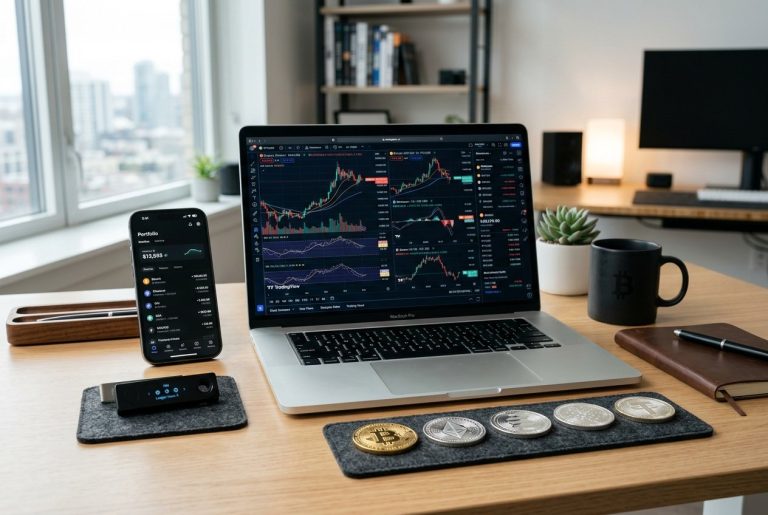
How to Use Crypto Trading Charts Like a Pro: Complete Step-by-Step Guide With Real Examples

Crypto trading charts might look intimidating at first glance, but honestly, they just tell the story of price moves and how the market’s behaving. If you learn to read these charts properly, you’ll spot trends, pick out smart entry and exit points, and make choices that aren’t just wild guesses.
Most beginners freeze up when they see all those lines, candles, and indicators, but once you get the hang of a few basics, it’s not so bad.

Reading cryptocurrency charts is about recognizing candlesticks, volume bars, and a handful of indicators that hint at what prices have done—and what they might do next.
Every piece on a chart has its own job. Once you know what to look for, you’ll start noticing patterns that pop up across all sorts of coins and timeframes.
This guide breaks chart reading into clear steps with real examples. You’ll see how to spot trends and make better trades by focusing on the most important chart elements, dodging beginner mistakes, and using strategies pros lean on every day.
Key Takeaways
- Crypto charts show price moves using candlesticks, volume, and indicators that reveal market trends.
- Spotting chart patterns and using the right tools helps traders make decisions based on facts—not feelings.
- Practice with real charts, step by step, to build skills that work for any coin or timeframe.
Understanding Crypto Trading Charts
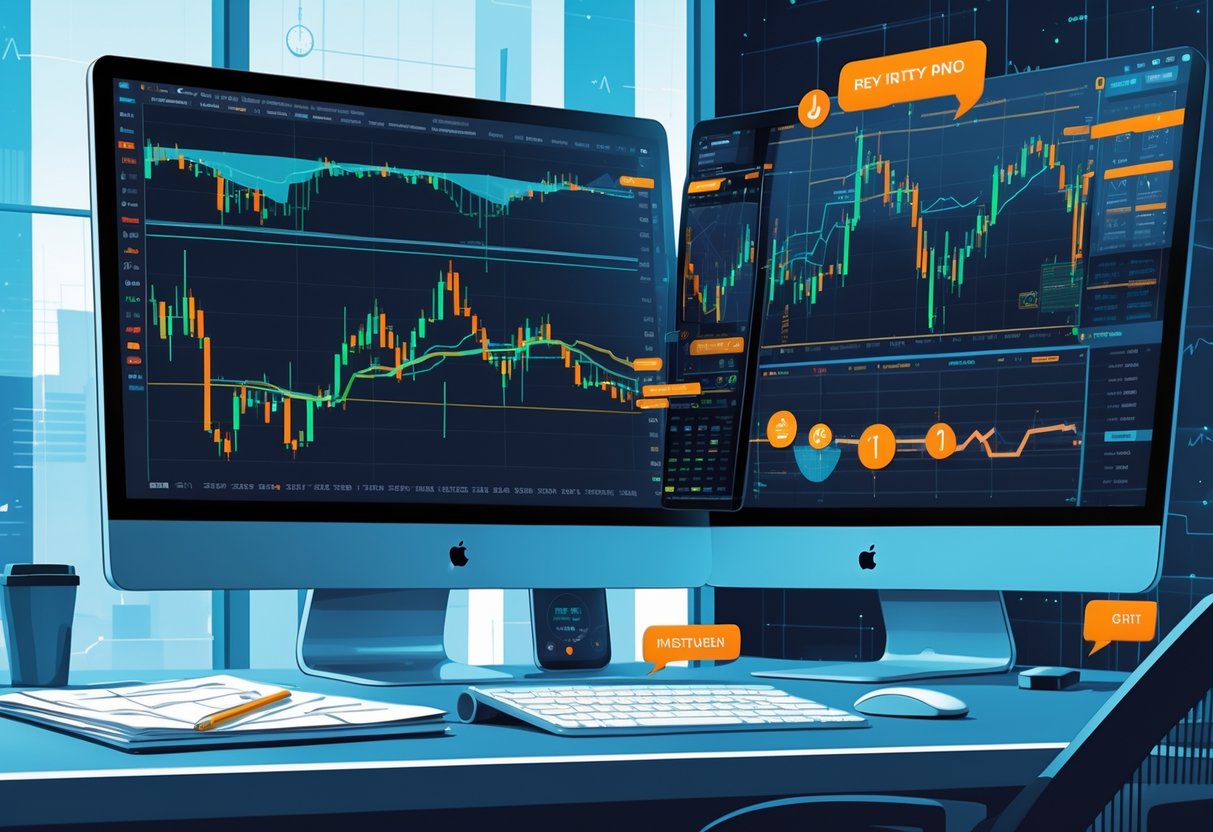
Crypto trading charts show how prices move over time. They use visuals like candlesticks and line graphs, and each type gives you a different angle on market action and volume.
What Are Crypto Trading Charts?
Crypto trading charts are tools that let you see how a coin’s price changes over a set period. The vertical axis is price, and the horizontal one is time.
These charts make it easier to spot market patterns. You can quickly tell if a coin’s going up, down, or just drifting sideways.
Most crypto trading charts include price levels, time frames, and volume bars. They pull live data from exchanges to show you what’s happening right now. Traders use this info to time their buys and sells.
Types of Crypto Trading Charts
Line charts connect closing prices with a single line. They’re simple and show the direction of price, but you don’t get the full story—no highs, lows, or opening prices.
Bar charts show four prices for each period: open, high, low, and close. The vertical line is the range, and little horizontal lines mark where things started and ended.
Candlestick charts are the favorite for most traders. Each candle shows the same four prices as bar charts, but colored bodies make things easier to read. Green or white means the price closed higher than it opened, red or black means it closed lower.
How Price Data Is Displayed
Price data comes in all sorts of timeframes—from one minute to a whole month or more. Short timeframes like 5 or 15 minutes are for fast moves, while daily or weekly charts are better for seeing the big picture.
The price scale usually sits on the right and shifts as prices move, so you can always see what’s happening.
Volume bars, down at the bottom, show how much of a coin traded during each period. Big volume means more action. This helps you figure out if a price move is for real or just noise.
Essential Chart Types for Crypto Traders

Traders mostly stick to three chart types to track prices and make calls. They all show the same data, but each one highlights something different about the market.
Candlestick Charts Explained
Candlestick charts are the go-to for crypto traders. Each candle shows open, close, high, and low for a set time.
The body of the candle is the range between open and close. Green or white means it closed up, red or black means it closed down. The thin lines—wicks or shadows—show the highest and lowest points reached.
Traders like candlestick charts because they make it easy to spot trends and guess at reversals. The colors and shapes tell you a lot, fast.
Line Charts Overview
Line charts are as simple as it gets—just a line connecting closing prices over time. You can track a coin’s general direction across any period.
They’re great for beginners who want the basics without getting lost in details. If you want to know if a price is generally rising or falling, line charts do the trick.
But line charts skip opening prices, highs, and lows. So, they’re not ideal for deep analysis—more for a quick look.
Bar Charts and Their Benefits
Bar charts show the same four points as candlesticks, just with a different look. Each vertical bar is the high-to-low range, and the little lines on the sides show where things opened (left) and closed (right).
They’re a bit trickier to read, but some traders like the cleaner look—especially when comparing lots of timeframes. Bar charts are handy for spotting exact support and resistance spots, too.
Reading Key Chart Elements

Every crypto chart gives you a handful of data points that matter most. Getting comfortable with timeframes, volume, and OHLC data is key for reading charts well.
Timeframes and Their Importance
Timeframes decide how price data is grouped. On a 1-minute chart, each candle is one minute; on a daily chart, it’s one day.
Short-term traders use 5, 15, or 60-minute charts to catch fast moves. These help with timing buys and sells for day trades. Long-term investors focus on daily, weekly, or even monthly charts to catch bigger swings.
Common timeframes include:
- 1m, 5m, 15m – Best for scalping and quick trades
- 1h, 4h – Good for day trades and swing plays
- 1D, 1W – Used for position trades and long-term views
The same coin can look totally different depending on the chart’s timeframe. You might see an uptrend on the daily, but a downtrend on the hourly. It’s smart to check more than one before making a move.
Volume Indicators on Charts
Volume indicators show how much of a coin traded in a certain period. They’re those vertical bars under the price chart—taller bars mean more trades.
High volume with a price jump means buyers are fired up. If prices drop with high volume, sellers are in charge. Low volume moves? They’re usually not convincing and might reverse fast.
Volume backs up price trends. If prices rise and volume climbs, the move is probably strong. If prices go up but volume drops, the trend might be losing steam.
Key volume patterns:
- Volume spike – Usually means big news or lots of interest
- Declining volume – Shows the trend is fading
- Volume at breakouts – Tells you if a price move is legit
Watch for volume spikes near support or resistance. They can signal reversals or breakouts you don’t want to miss.
Open, High, Low, Close (OHLC) Data
OHLC shows four prices for each period: open (first trade), high (top price), low (bottom price), and close (last trade).
Candlestick charts pack all four into one visual. The body is open to close, and the wicks show high and low.
Green or white means the close was higher than the open. Red or black means it closed lower. The size of the candle and wicks tells you if there was lots of action or just a little back-and-forth.
Understanding OHLC data helps spot patterns and guess at what’s next. Long wicks can mean rejection at certain prices, while candles with tiny bodies and long wicks show indecision.
Technical Indicators and Tools
Traders use math-based tools built from price and volume data to find good entry and exit points. The three most-used indicators help spot trends, measure momentum, and flag when a coin might be overbought or oversold.
Moving Averages in Crypto Charts
Moving averages smooth out price swings to show the bigger trend. They calculate the average price over a set number of periods, then update as new data comes in.
The Simple Moving Average (SMA) adds up closing prices over, say, 50 days and divides by 50. The Exponential Moving Average (EMA) gives more weight to recent prices, so it reacts faster to changes.
Traders look for crossovers. When a short-term average crosses above a long-term one, it usually means an uptrend. If it crosses below, it might signal a downtrend. The 50- and 200-day moving averages are a classic combo for spotting major trend shifts in crypto.
Relative Strength Index (RSI)
RSI measures how quickly and how far prices are moving. It’s a line that runs from 0 to 100 and helps you see if a coin’s overbought or oversold.
If RSI goes above 70, the coin might be overbought—meaning a pullback could be coming. If it drops below 30, it might be oversold and due for a bounce.
The RSI looks at gains versus losses over 14 periods. Traders also watch for divergence—if price hits a new high but RSI doesn’t, it could mean momentum’s fading and a reversal is on the way.
Bollinger Bands Usage
Bollinger Bands use three lines to show how volatile a price is and where support or resistance might form. The middle line’s usually a 20-period simple moving average. The upper and lower bands sit two standard deviations away from it.
When the bands get wider, that means the market’s more volatile. If they squeeze together, things are pretty calm. If the price touches or breaks through the upper band, some traders think the asset’s getting overbought. Hitting the lower band might mean it’s oversold.
People watch for a “squeeze”—when the bands get super narrow. This tightness often comes before a big move, though it’s not always clear which direction. Bands can act like moving support and resistance, with prices bouncing between them in sideways markets.
Identifying Chart Patterns
Chart patterns are shapes that pop up on price charts over and over. They can help predict where prices might go, but nothing’s certain. These patterns form because buyers and sellers keep reacting at similar levels, making recognizable shapes.
Support and Resistance Zones
Support is just a price level where buyers keep stepping in, stopping prices from falling further. If a crypto hits the same support level several times and doesn’t drop through, that area gets stronger.
Resistance is the flip side. It’s a level where sellers show up and cap price rallies. For example, if a coin hits $50,000 three times but can’t break above it, that’s solid resistance.
To spot these zones, look for prices that bounce at the same spot again and again. The more times a price tests a level without breaking it, the more important it gets. When price finally pushes through resistance, that old ceiling often turns into a new floor.
Key indicators of strong zones:
- Price touches the same level multiple times
- Heavy trading volume near the zone
- Sharp price reversals at the area
- Round numbers that catch everyone’s eye
Trendlines and Channels
Trendlines are simple. Connect two or more price points and you’ll see which way the market’s leaning. If you link rising lows, that’s an uptrend. Connecting falling highs? Downtrend.
Channels form when prices bounce between two parallel trendlines. The top line’s resistance, the bottom’s support. Prices usually ping-pong inside until something gives and there’s a breakout.
For a solid trendline, you want at least two points, but three or more is even better. Don’t force the line through every wiggle—just connect the most obvious highs or lows. Here’s a good resource on recognizing and using chart patterns.
Reversal Patterns
Reversal patterns can hint that the current trend’s about to flip. The classic head and shoulders pattern has three peaks—the middle one (the “head”) is higher than the others (“shoulders”). This usually shows up before a drop.
Double tops and double bottoms are easier to spot. Double top? Price hits the same high twice, then falls. That’s an M shape. Double bottom? Price bounces off the same low twice, forming a W before heading up.
Spotting trend changes isn’t just about the pattern. You want confirmation from volume and price action. For head and shoulders, it’s only valid if price breaks below the neckline—the line connecting the pattern’s lows. Volume tends to spike on the breakout. There’s more on this at this guide.
Continuation Patterns
Continuation patterns suggest the trend will keep rolling after a quick breather. Flags and pennants are popular here, especially in strong trends.
A bull flag looks like a sharp rise, then a sideways or slightly downward pause, before another jump. Bear flags are the same but flipped for downtrends. These don’t last long—usually a week or two at most.
Triangles are another type. Ascending triangles have a flat top and rising bottom, hinting at a breakout up. Descending triangles have a flat bottom and falling top, pointing to a possible drop. Watch for volume to pick up when price breaks out to confirm the move—more on that here.
Step-by-Step Guide to Analyzing a Crypto Chart
Getting started with chart analysis isn’t rocket science, but it does help to have a process. You’ll want to set up your chart, pick a timeframe, and add some technical tools. That’s how most traders begin.
Setting Up the Chart Interface
Most crypto exchanges let you tweak your chart interface to track price moves. First, pick a chart type—candlestick charts are the usual favorite.
Candlesticks show four prices for each period: open, close, high, and low. If the candle’s green or white, price went up. Red or black? Price dropped.
Adjust the zoom so you see enough data without making things messy. Most platforms let you switch between dark and light themes, which is a lifesaver for your eyes during long sessions. The y-axis is price, and the x-axis is time.
Selecting the Right Timeframe
Timeframes change what you see. Short-term traders use 1-minute to 1-hour charts for quick action. Swing traders go for 4-hour or daily charts. Long-term folks stick to daily, weekly, or even monthly charts.
Day trading? Try a 15-minute chart—it’s detailed but not too noisy. Daily charts are better for spotting big-picture trends. A lot of traders check several timeframes before making a call.
The timeframe should fit your plan. If you’re holding for weeks, don’t obsess over 5-minute candles. If you’re trading in and out within hours, skip the weekly charts.
Adding and Interpreting Indicators
Indicators are tools that help spot trends or reversals. The classics are moving averages, RSI, and MACD.
Moving averages smooth out the price so you can see the trend. If the 50-day moving average crosses above the 200-day, that’s often a bullish sign. Price staying above its moving average? That’s usually good news for bulls.
RSI tells you if something’s overbought or oversold, from 0 to 100. Over 70? Maybe too hot. Under 30? Could be oversold. MACD compares two moving averages to show momentum shifts. These indicators work best together, not alone.
Real-World Examples of Crypto Chart Analysis
It’s one thing to talk theory, but seeing real chart patterns in action makes it click. Here are some examples of what traders actually look for—and what they might do about it.
Spotting a Bullish Breakout
A bullish breakout happens when price busts through resistance with strong volume. If a coin’s been stuck for days or weeks, then suddenly surges higher, that’s what you want to see.
Bitcoin’s famous for this around big round numbers like $30,000 or $40,000. Look for a tall green candle, trading volume that’s double or triple the usual, and price holding above the breakout level.
What traders do:
- Buy when price closes above resistance
- Put a stop-loss just under the breakout area
- Target the next resistance for profits
The best breakouts usually come after a stretch of low volatility, when price has been consolidating tightly. That tension has to go somewhere, and eventually it pops.
Recognizing Bearish Signals
Bearish signals warn of a possible drop. Patterns like lower highs and lower lows make a clear downtrend.
The head and shoulders pattern is a classic bearish sign. Three peaks, with the middle one the highest. If price breaks below the neckline, it often keeps falling.
Key bearish indicators:
- Falling volume on price bounces
- RSI above 70 (overbought)
- Moving averages crossing downward
- Bears-only candlestick patterns like shooting stars
Ethereum has flashed these signals before big corrections. Savvy traders don’t trust just one sign—they look for a few lining up.
Example: Day Trading With Charts
Day traders use short-term chart analysis to jump in and out of trades within a single day. They mostly watch 5-minute or 15-minute candlestick charts for quick moves.
Say a trader spots a double bottom on a 15-minute chart—price bounces off the same support twice. That’s a hint buyers are defending that level.
They might buy when price breaks above the peak between the bottoms, using a tight stop-loss below the second bottom and aiming for a quick 1–2% profit. Volume should pick up on the breakout.
MACD is another favorite for day traders. If the MACD line crosses above the signal line, that usually means momentum’s shifting up.
Common Mistakes When Using Crypto Charts
Honestly, a lot of traders lose money not because they don’t know enough, but because they get in their own way. The biggest mistakes? Using too many indicators, ignoring the bigger market, and thinking technicals are all that matter.
Overcomplicating Chart Analysis
Newbies love to pile on every indicator they can find—moving averages, RSI, MACD, Bollinger Bands, Fibonacci, you name it. It just turns the chart into a mess and makes decisions harder, not easier.
Your brain can only juggle a few data points at once. If you’ve got ten indicators, each saying something different, you’ll freeze or make snap decisions. This is a classic mistake.
Pros usually stick to two or three tools that work well together. Maybe a moving average for trend, RSI for timing. That’s enough to see what matters without drowning in info.
Start simple. Figure out what each indicator actually does, and how it fits with price action. Once you’re comfortable, add more if you really need to.
Ignoring Larger Market Trends
It’s easy to get excited about a bullish setup on a 15-minute chart—until you realize Bitcoin’s tanking on the daily. Short-term patterns just don’t win against big-picture moves.
Most of the crypto market moves together. If Bitcoin drops 10%, almost every altcoin follows, chart patterns or not. Focusing only on one timeframe means you’ll miss the bigger story.
Check the daily or weekly chart first to see the main trend, then zoom in for trade entries. Your short-term trades should agree with the bigger trend.
Don’t forget about market news or global events. Regulatory changes, exchange hacks, or stock market crashes can hit every crypto at once. A perfect technical setup won’t save you if the whole market’s in panic mode.
Relying Solely on Indicators
Technical indicators just reflect what price has already done. They can’t predict surprise news, hacks, or sudden rule changes.
Traders who only pay attention to chart lines often get blindsided. Volume analysis adds a layer of context that price indicators alone totally miss.
A breakout with barely any volume? That usually fizzles out. But if volume surges, the breakout’s got a better shot at sticking.
Sometimes price shows a bullish setup, but the volume tells you hardly anyone’s buying into it. That’s a red flag.
Making informed trading decisions means you have to look beyond just the technicals. Some of the big factors are:
- Trading volume: Confirms if price moves have real backing.
- Market sentiment: Reveals if fear or greed is in the driver’s seat.
- News events: Can move price regardless of what the charts say.
- Whale movements: Big holders can move the market in a flash.
Smart traders use charts as just one tool. They check on-chain data, follow project updates, and keep an eye on what people are saying online.
If technical signals line up with these other factors, the trade feels a lot more solid.
Advanced Tips for Pro-Level Chart Reading
Getting good at chart analysis means using several tools together, tweaking your approach as the market shifts, and building up fast pattern recognition.
Combining Multiple Indicators Effectively
Mixing indicators gives stronger trading signals than leaning on just one. Most traders pair trend indicators with momentum oscillators to double-check price moves before jumping in.
A popular combo is moving averages with the Relative Strength Index (RSI). If price pops above the 50-day moving average and RSI is over 50, that’s usually a sign of upward momentum.
Another go-to is Bollinger Bands with the MACD for spotting breakouts.
Effective Indicator Combinations:
| Primary Indicator | Supporting Indicator | What It Confirms |
|---|---|---|
| Moving Averages | RSI | Trend direction and strength |
| Bollinger Bands | Volume | Breakout validity |
| MACD | Stochastic Oscillator | Momentum shifts |
| Support/Resistance | Fibonacci Retracement | Entry and exit points |
Don’t overload your chart with indicators. Three or four that complement each other is plenty—any more and you’re likely to get mixed signals.
Each indicator should have a job, not just fill up space.
Adapting Strategies to Market Conditions
Markets aren’t always the same, so your chart reading shouldn’t be either. Bull markets call for trend-following, but in sideways markets, range-trading works better.
When things get volatile, traders widen their stop losses and look at longer timeframes to avoid getting whipsawed. In calmer markets, you can tighten stops and zoom in on shorter intervals.
Understanding crypto trading charts gets easier when you know what kind of market you’re in.
Market conditions shift due to:
- News and regulatory updates
- Overall market mood
- Volume spikes or drops
- Time of day or week
Good traders check multiple timeframes before acting. A 4-hour chart might look bullish, but the daily could be bearish. Usually, the higher timeframe wins out.
Improving Speed and Accuracy
Speed comes from practice—lots of it. If you’re looking at charts every day, you start to spot setups in seconds, not minutes.
Having a pre-trade checklist keeps you honest under pressure. It should cover trend direction, support and resistance, indicator signals, and volume. With experience, you’ll blast through this in half a minute.
To get faster, try:
- Using chart templates with your favorite indicators
- Setting price alerts
- Reviewing old charts to see how patterns played out
- Paper trading to practice without risking cash
Honestly, screen time matters more than just reading about charts. Spend 30 minutes a day on real charts and you’ll improve way faster than just studying theory.
The skill to read charts like professionals comes from seeing real market moves, not just memorizing patterns.
After hundreds of examples, you’ll spot head and shoulders, triangles, and wedges almost automatically. It starts feeling like second nature.
Frequently Asked Questions
New traders usually get tripped up by basics like candle patterns and timeframes. More experienced folks want to know which tools and strategies actually set day traders apart from long-term investors.
What are the essentials of reading crypto charts for complete beginners?
Beginners need to grasp three things when reading crypto charts: the vertical axis is price, the horizontal axis is time, and the chart visuals show price movement. This is the backbone of all chart reading.
First, pick between line charts and candlestick charts. Line charts just connect the closing prices, so they’re simple to read. Candlesticks give you more—they show open, close, high, and low for each period.
Time intervals matter a lot. If you’re on a 1-hour chart, each candle is an hour. A daily chart? Each candle is a day. Beginners should stick to daily or 4-hour charts at first—it’s less overwhelming.
Volume bars sit at the bottom and show how much crypto changed hands. High volume means the move is legit. Low volume? Maybe not so much.
Can you provide a step-by-step guide to understanding crypto candles?
Each candlestick has a body and two wicks (or shadows). The body is the space between open and close. Wicks stretch out to the highest and lowest prices in that time.
Green or white candles mean the close was higher than the open. Red or black means it closed lower. The color gives you a quick read on who’s in control—buyers or sellers.
A big candle body shows strong buying or selling. Small body? That’s indecision.
Long wicks mean price got rejected at those levels. A long upper wick? Buyers pushed up, but sellers shoved it back down. A long lower wick? Sellers tried to drive it down, but buyers pushed back up.
Some patterns send clear trading signals. A doji (tiny body, long wicks) means the market’s undecided. A hammer (small body at the top, long lower wick) can signal a reversal from a downtrend.
What are the key features to look for in TradingView as a crypto trading tool?
TradingView has loads of chart types: candlestick, line, bar, and Heikin-Ashi. You can flip between them to see price action from different angles. The platform streams real-time data for thousands of crypto pairs.
Drawing tools let you mark up support and resistance right on your chart. Horizontal lines show where buyers or sellers have stepped in before. Trend lines connect the dots on swings to show overall direction.
Built-in indicators help you analyze price trends and momentum. There are over 100 to choose from—moving averages, RSI, MACD, Bollinger Bands, and more. You can stack them on one chart and tweak the settings.
The alert system is handy. You can set it to ping you when price hits certain levels or when an indicator triggers. Alerts come through email, SMS, or push notification.
TradingView also makes it easy to look at multiple timeframes at once. That way, you can see if short-term moves line up with the bigger trend.
How do day traders read crypto charts differently from long-term investors?
Day traders stick to short timeframes—1-minute, 5-minute, 15-minute—to catch quick price moves. They need to see what’s happening right now. Long-term investors look at daily, weekly, or monthly charts for the bigger picture.
Indicators play different roles. Day traders love momentum tools like RSI and MACD for fast entries and exits. Long-term investors use moving averages and trend lines to stay focused on the overall direction and tune out the noise.
Volume matters a ton for day traders—they need to know there’s enough action to get in and out. They watch for sudden spikes that signal big players moving. Long-term investors care more about volume trends over weeks or months.
Day traders look for patterns that finish in hours or a day—bull flags, pennants, double tops. Long-term investors hunt for bigger patterns like cup and handles or months-long triangles.
Risk management’s a whole different ballgame. Day traders set super tight stops—1-2%—because they’re in and out all day. Long-term investors use wider stops, sometimes 10-20%, to avoid getting shaken out by normal volatility.
What resources are recommended for learning crypto trading at no cost?
YouTube channels focused on crypto technical analysis are a solid starting point. There are tons of free video tutorials covering everything from chart reading basics to some pretty advanced strategies.
Many seasoned traders actually walk through their setups and break down their analysis in real-time. Watching these videos, you get a sense of how pros handle charts in live market conditions—sometimes it’s messier than you might expect.
Most crypto exchanges also toss in educational sections on their sites. You’ll find articles and guides about chart analysis, candlestick patterns, indicators, and risk management—stuff they want you to know so you stick around and trade more.
Some exchanges even host webinars where you can ask questions directly. It’s a pretty handy way to get answers from people who know what they’re doing.
Then there’s TradingView’s public chart library. It’s packed with thousands of analyses shared by traders all over the world.
You can browse through how others mark support and resistance, draw trend lines, and mess with indicators. The community posts their trade ideas and usually explain what they’re thinking, which is honestly super helpful.
And don’t forget about free demo accounts from exchanges. These let you practice with reading trading charts using real market data—no actual money on the line.
You can mess around with different timeframes, try out indicators, and just see what works (or doesn’t) without the stress. It’s not a bad way to build a bit of confidence before you put real cash at risk.
This article is not financial, investment, legal, or tax advice. Crypto assets and prediction markets can involve substantial risk. Verify sources independently and make your own decisions.
Follow the work without joining another hype machine.
Get new dispatches, tool notes, and market research through the free MemeQuake Telegram community.